 blog
blog
Is Medical Grade Sanitation Worth It for Nail Salons?
Table of Contents
- What Medical Grade Sanitation Actually Means for a Nail Salon
- Nail Salon Hygiene Standards OSHA Expects You to Meet
- The Real Cost of Medical Grade Sanitation (and What It Saves You)
- How to Sanitize Nail Tools at Home (and Why It's Not Enough for a Salon)
- Verification and Testing: How to Prove Your Sanitation Works
- Staff Training Requirements for Medical Grade Sanitation
- Sustainability vs. Efficacy: Can You Have Both?
- Frequently Asked Questions
Last Updated: September 20, 2026
What Medical Grade Sanitation Actually Means for a Nail Salon
Medical grade sanitation is a multi-step process that kills harmful germs on tools and surfaces to a clinical standard. For a nail salon, that means more than a quick wipe-down. It means cleaning, then disinfecting with an EPA-registered product, for the full contact time the label requires.
At Coastal Polish & Beauty, we treat this as the baseline, not a bonus. The tools that touch your nails and skin should meet the same germ-killing standard you would expect in a clinic.
So, is medical grade sanitation worth it? For any salon that cares about its clients, the answer is yes. Here is what it involves and why it matters.
The Difference Between Cleaning, Sanitizing, and Disinfecting
These three words get used as if they mean the same thing. They do not.
- Cleaning removes visible dirt and debris. It does not kill germs.
- Sanitizing lowers the germ count to a safer level. It does not wipe them all out.
- Disinfecting kills most germs on a surface. This is the step that protects clients.
A salon that only cleans is leaving germs behind. Proper disinfection is what stops the spread of infection.
Nail Salon Hygiene Standards OSHA Expects You to Meet
The Occupational Safety and Health Administration sets rules that protect workers from blood-borne pathogens. Salons fall under these rules because nicks and cuts happen. A tiny cut can expose a technician to viruses carried in blood.
OSHA expects salons to follow a written exposure control plan. The plan covers how to handle sharps, how to clean up blood, and how to protect staff. It also covers gloves, eye protection, and safe disposal of waste.
These are not optional. Salons that skip them put both staff and clients at risk. For the full requirements, see the OSHA blood-borne pathogens standard.
Good hygiene standards protect everyone in the chair.
The Real Cost of Medical Grade Sanitation (and What It Saves You)
Medical grade sanitation costs more up front. You pay for better disinfectants, an autoclave, and staff training. But the cost of a lapse is far higher, and most salon owners never actually run the numbers on either side. Here is a framework for doing that.
Breakdown of Supplies, Equipment, and Training Costs
Here is where the money goes, and roughly what each line item runs in a typical small salon:
- EPA-registered hospital-grade disinfectant concentrate, a gallon of concentrate that dilutes to many ready-to-use quarts typically runs in the low-to-mid double digits; diluted correctly, it lasts months.
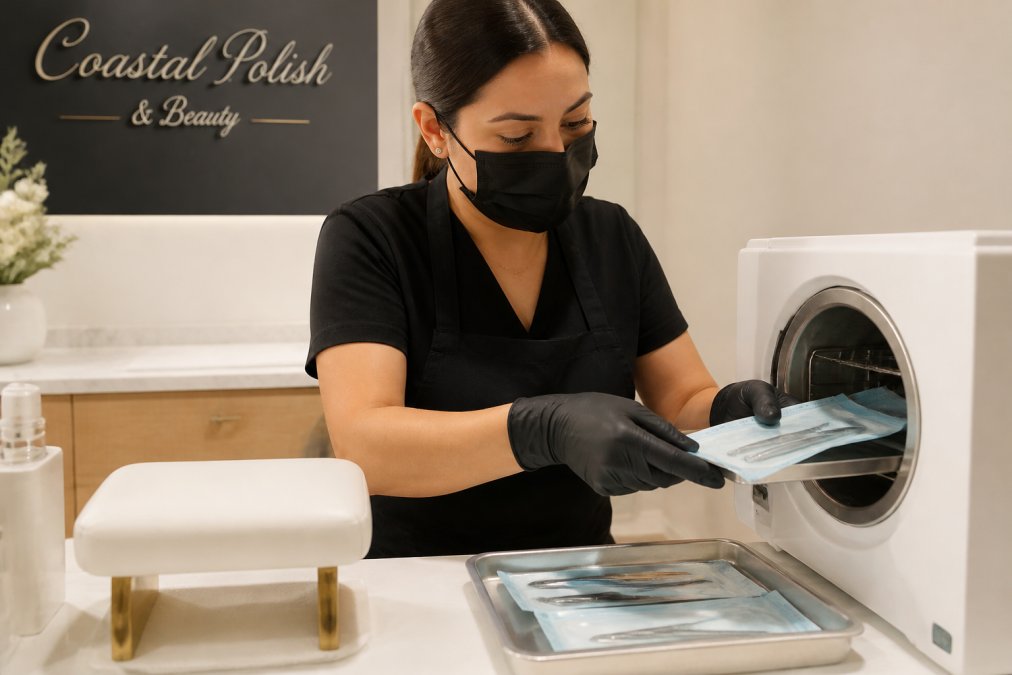
- Autoclave (tabletop, Class B or Class S), the single largest capital cost. Small units sized for a nail station generally land in the low four figures. Class B units (which pull a vacuum and sterilize wrapped instruments) cost more than basic gravity units but are what most infection-control guidance points to for tools that contact broken skin.
- Single-use files, buffers, and pedicure liners, pennies per client, but they add up. Budget per-service, not per-month.
- Gloves, masks, and eye protection, nitrile gloves are the standard; expect a few cents per pair at volume.
- Ongoing training, many state cosmetology boards require infection-control hours for license renewal, so some of this is already baked into your continuing-education budget.
- Verification supplies, ATP swabs and autoclave spore tests (covered in the next section) are consumables with a real per-test cost.
Pricing moves with quantity, brand, and your supplier relationship, so treat the above as order-of-magnitude, not quotes. The point is that the recurring cost is dominated by consumables and the one-time cost is dominated by the autoclave.
How to Calculate Your Return on Investment
The math is simple once you frame it as retention, not as a hygiene expense.
- Add up your monthly sanitation costs. Include consumables, amortize the autoclave over its expected service life (typically several years), and add any incremental training hours.
- Estimate the lifetime value of one repeat client. Take your average ticket, multiply by visits per year, then multiply by the number of years a typical client stays. For a regular manicure client, that number is usually well into the hundreds of dollars, often four figures over the full relationship.
- Estimate how many clients one infection complaint would cost you. A single verified infection traced to your salon can trigger bad reviews, word-of-mouth damage, and in some states a board complaint or inspection. Even a conservative estimate, a handful of lost regulars plus a dip in new bookings, usually dwarfs a year of sanitation spend.
Run those three numbers and the comparison is rarely close. If your monthly sanitation cost is X and the lifetime value of a single retained client is several times X, you only need to retain one client per period to break even on the whole program. Everything past that is margin.
How to Sanitize Nail Tools at Home (and Why It's Not Enough for a Salon)
Home cleaning is fine for personal tools. It is not enough for a busy salon.
Schedule and Appointment today for 10% Off your service →
Here is how to sanitize nail tools at home:
- Scrub tools with soap and warm water to remove debris.
- Soak metal tools in 70% isopropyl alcohol for 10 minutes.
- Dry tools fully on a clean towel.
- Store them in a sealed, clean container.
That routine helps for one person. But a salon handles many clients a day. It needs stronger products, a heat sterilizer, and a logged process. Home methods cannot match that.
Verification and Testing: How to Prove Your Sanitation Works
You cannot claim clean tools without proof. That is where testing comes in, and it is the step almost every salon guide skips.
ATP Testing: What It Actually Measures
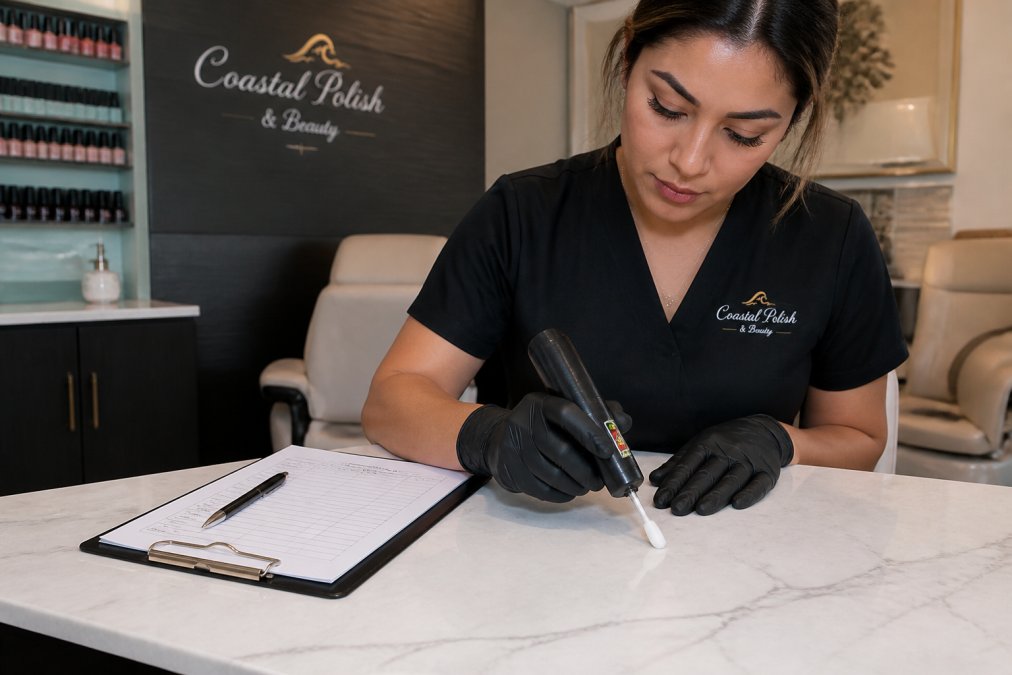
An ATP swab does not detect germs directly. It detects adenosine triphosphate, the energy molecule present in all living cells, including bacteria, fungi, and the organic residue left behind by skin and soil. The swab is rubbed across a defined area (typically a 10x10 cm square, or about 4x4 inches), then activated with a reagent. A handheld luminometer reads the reaction and returns a number.
The number is the point. A low reading means the surface is free of the organic load that feeds and hides pathogens. A high reading means something was left behind, residue, biofilm, or a surface the disinfectant never actually reached.
Autoclave Spore Testing: The Only Real Proof of Sterilization
An autoclave can display the right temperature and pressure and still fail to sterilize, because air trapped in the chamber or a bad gasket can prevent steam from reaching the load. The only way to know it worked is a biological indicator.
Building a Log That Holds Up
A written log is what turns a claim into a fact. It is also what an inspector or a nervous client wants to see. A useful log records:
- Date, time, and operator for each disinfection and sterilization cycle
- The disinfectant used, its dilution, and the contact time observed
- ATP swab results by surface and location
- Spore test results, including lot numbers and incubation outcome
- Any failed test, the corrective action taken, and the re-test result
Staff Training Requirements for Medical Grade Sanitation
Even the best products fail in untrained hands. Training is what makes sanitation work.
- How to clean tools before disinfecting
- How long to soak tools in each product
- How to run and test the autoclave
- How to handle cuts and blood safely
- When to use gloves and other protection
Sustainability vs. Efficacy: Can You Have Both?
Many salon owners worry that going green means giving up germ-killing power. That trade-off is not as sharp as it used to be.
You can reduce waste without cutting corners:
- Choose reusable metal tools you sterilize, not throwaway ones.
- Pick concentrated disinfectants to cut plastic use.
- Use refillable bottles for soaps and lotions.
- Recycle packaging where your city allows it.
Frequently Asked Questions
Is medical-grade sanitation necessary for nail salons?
Medical-grade sanitation is not always legally required, but it is the most reliable way to prevent infections. Standard cleaning removes visible debris but does not kill all pathogens. Medical-grade disinfection uses EPA-registered hospital-grade products that eliminate blood-borne pathogens and fungi. For salons that reuse tools, this level of sanitation protects clients from cross-contamination and protects the business from liability.
What is the difference between hospital-grade and medical-grade disinfectants?
The terms are often used interchangeably, but hospital-grade disinfectants are EPA-registered to kill specific pathogens listed on their label. Medical-grade sanitation typically refers to the full protocol: cleaning, disinfection with an EPA-registered product, proper dwell time, and sterile storage. A hospital-grade product is one part of a medical-grade process. The key is following the label's dwell time and using the correct concentration.
How can clients identify if a salon uses medical-grade sanitation?
Clients can ask to see the salon's disinfection log or the EPA registration number on the disinfectant bottle. A salon committed to medical-grade sanitation will happily show these. Other signs include sealed sterile tool pouches opened in front of the client, single-use files and buffers, and technicians who wash hands and wear gloves. If a salon is vague about its process, that is a red flag.
What are the risks of using standard cleaning products in a wellness setting?
Standard cleaning products like soap and water remove dirt but do not kill pathogens such as Staphylococcus aureus, hepatitis B, or fungi that cause nail infections. In a wellness setting where tools contact skin and nails, this leaves clients vulnerable to cross-contamination. It also puts the business at risk for OSHA violations and potential lawsuits. Medical-grade disinfection closes that gap.