 blog
blog
Top Rated Head Spa in Newport: What to Expect in 2026
Table of Contents
- Why a Head Spa Became Newport's Favorite Wellness Ritual
- Japanese Head Spa Benefits: Circulation, Calm, and Cleaner Scalp
- What to Expect From Head Spa Appointments, Start to Finish
- Head Spa Treatment Duration: How Long Each Session Runs
- Who Should Skip a Head Spa: Safety and Contraindications
- After Your Head Spa: At-Home Care That Protects Results
- How to Choose a Top Rated Head Spa in Newport
- Frequently Asked Questions
Last Updated: September 10, 2026
Why a Head Spa Became Newport's Favorite Wellness Ritual
A head spa is a dedicated scalp and hair treatment that combines deep cleansing, exfoliation, and massage to support follicle health and reduce tension. At Coastal Polish & Beauty, we offer this Japanese-inspired ritual for clients who want a genuine reset rather than another rushed appointment.
The appeal is simple: it treats the scalp as skin, not an afterthought.
Most hair care focuses on strands. A head spa focuses on the foundation beneath them. That shift in attention is why so many people searching for a top rated head spa in Newport are booking sessions as part of their regular wellness routine instead of saving them for special occasions.
Japanese Head Spa Benefits: Circulation, Calm, and Cleaner Scalp
Japanese head spa benefits fall into three categories: better scalp condition, measurable relaxation, and stronger-looking hair over time. The treatment works because it addresses circulation, buildup, and tension at the same time, but the reason it works is worth understanding, because it separates a genuine scalp treatment from a pleasant shampoo.
Here's what that looks like in practice, and the mechanism behind each one:
- Circulation stimulation. Structured massage creates localized vasodilation, the widening of small blood vessels near the surface of the scalp. That increased blood flow supports the delivery of oxygen and nutrients to the hair follicle, the structure responsible for anchoring and growing each strand. Consistent, gentle pressure is generally preferred over aggressive rubbing, which can irritate rather than help.
- Sebum regulation. The scalp produces sebum, a natural oil that protects the skin barrier. Over-washing and harsh surfactants strip it, prompting the scalp to overproduce oil in response. A head spa uses gentler cleansing and exfoliation to remove excess buildup without triggering that rebound, which can leave the scalp feeling balanced rather than tight.
- Stress relief. Slow, deliberate touch engages the parasympathetic nervous system, the branch responsible for rest and recovery. That's the physiological reason a head spa feels different from a quick shampoo at a salon sink.
- Deep conditioning. A finishing mask restores moisture to the hair shaft and scalp without the heavy residue that weighs down fine hair.
Many clients describe the experience as closer to a wellness ritual than a beauty service. That's the point.
What the Research Says About Scalp Health and Stress
Dermatologists generally agree that a healthy scalp environment supports healthier hair growth, and that stress can contribute to shedding and irritation. Guidance from the American Academy of Dermatology on hair and scalp care notes that gentle, consistent scalp care matters more than aggressive treatments.
The scalp microbiome, the community of microorganisms living on the scalp, plays a role in how well that environment holds up. Disrupting it with harsh products tends to backfire. A head spa works with that balance rather than against it.
It also helps to understand the hair growth cycle. Each follicle moves through phases: a growth phase, a transitional phase, and a resting phase before the hair sheds and the cycle restarts. Because follicles are at different stages at any given time, scalp health is cumulative, you're supporting the follicles that will produce hair weeks and months from now, not just the strands currently visible. That's why a single session feels good but a consistent routine changes the baseline.
What to Expect From Head Spa Appointments, Start to Finish
Every session follows a similar arc: consultation, scalp analysis, cleansing, exfoliation, massage, mask, and finish. Knowing the sequence removes the guesswork and lets you actually relax.
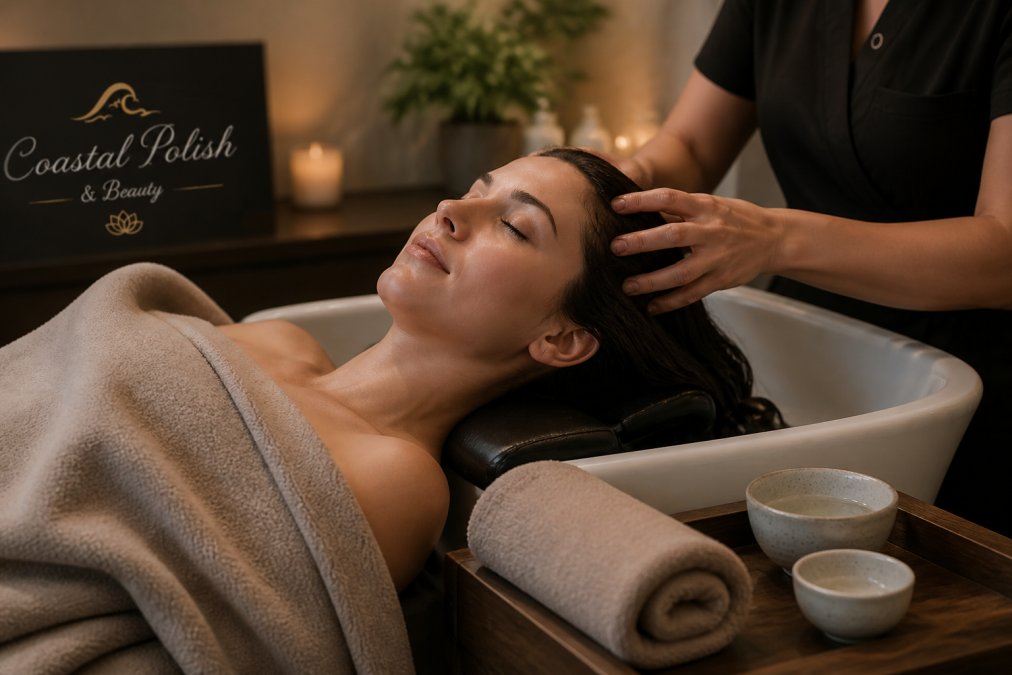
A typical appointment at Coastal Polish & Beauty begins with a short conversation about your scalp concerns, then moves into the treatment itself in a quiet, private room.
Scalp Analysis, Cleansing, and the Ginger-Infused Massage
The scalp analysis comes first. Your technician examines the scalp under magnification to check for buildup, dryness, or sensitivity, then adjusts the treatment accordingly.
Cleansing follows, using warm water and gentle products to lift product residue and excess oil. Exfoliation removes dead skin cells that can clog follicles. Then comes the ginger-infused massage, a warming technique that stimulates circulation and creates a signature sensory experience.
A rejuvenating hair mask and optional aromatherapy close the session.
Head Spa Treatment Duration: How Long Each Session Runs
Head spa treatment duration typically runs 60 to 90 minutes, depending on the service tier chosen. Shorter express versions exist, but they may not include all steps that contribute to the full treatment experience.
| Session Type | Typical Duration | Best For |
|---|---|---|
| Express scalp cleanse | 30-45 min | Maintenance between full sessions |
| Standard head spa | 60 min | First-time clients, regular upkeep |
| Extended ritual | 90 min | Deep relaxation, stressed scalps |
If you're booking for the first time, the 60-minute option gives you the full sequence without committing to the longer format. The extended session suits anyone dealing with significant tension or buildup.
Who Should Skip a Head Spa: Safety and Contraindications
A head spa is non-invasive, but it isn't right for everyone. Knowing the contraindications ahead of time protects you and saves a wasted appointment. Most guides may not cover this topic in depth. A scalp treatment involves exfoliation, massage, and product application, and each of those interacts with the condition of your skin.
Skip or postpone a session if you have:
- Open cuts, sores, or active infections on the scalp. Broken skin is a pathway for irritation and infection, and massage can spread bacteria across the scalp.
- Recent chemical burns from relaxers or color treatments. The scalp needs time to rebuild its barrier. It is generally recommended to wait until the skin is fully healed and no longer tender before booking.
- A diagnosed scalp condition currently in a flare-up. Conditions like seborrheic dermatitis, psoriasis, or eczema can be aggravated by exfoliation and fragrance. When the scalp is calm, a gentle treatment may be fine, but that's a conversation to have with your provider, and ideally your dermatologist, first.
- Recent head or neck surgery without medical clearance. Massage and positioning can affect healing tissue. Get a provider's sign-off before booking.
- An active allergic reaction or undiagnosed rash. If you don't know what's causing it, don't add new products or friction on top of it.
How a Professional Provider Screens You
The consultation isn't a formality, it's the safety step. A reputable provider will ask about your scalp history, recent chemical services, allergies, and any diagnosed conditions before the treatment begins. They'll examine the scalp under magnification and adjust or decline the service if something looks off.
If you're unsure, ask your technician before booking. A reputable provider will tell you honestly whether the treatment suits your situation rather than pushing you into a service.
When in doubt about a diagnosed scalp or skin condition, get clearance from a dermatologist before booking. A head spa is a wellness and cosmetic service, not a medical treatment, and it should never replace care for a medical issue.
After Your Head Spa: At-Home Care That Protects Results
The results last longer when your at-home routine supports them. To maintain results, it's generally recommended to avoid over-washing or piling on heavy products.
A few habits make a real difference:
- Wash with a gentle, sulfate-free shampoo two to three times per week
- Avoid heavy styling products directly on the scalp
- Use a wide-tooth comb on damp hair instead of a brush
- Keep a lightweight scalp serum on hand for between-session maintenance
What most guides miss is that scalp care is cumulative. One treatment helps. A consistent routine changes the baseline.
Booking your next session four to six weeks out can help each treatment build on the last.
How to Choose a Top Rated Head Spa in Newport
The right provider is the one that shows you its process, not just its photos. Ask three questions before you book: What does the consultation include? How are tools sanitized between clients? What's the cancellation and rebooking policy?
A reputable head spa should be able to answer these questions. If a provider can't explain its sanitation protocol clearly, that may be a red flag.
Look for these signals:
- A visible, explained sanitation process for every tool
- A consultation before the treatment starts
- Technicians who can describe the steps and the reasoning behind them
- A calm, private environment rather than a rushed open floor
At Coastal Polish & Beauty, our head spa sits inside the Birdhouse wellness collective, a setting built for exactly this kind of quiet, personalized care. Our team walks clients through the process.
For broader context on what separates a genuine scalp treatment from a surface-level one, the International Journal of Trichology on scalp treatments offers useful background on how scalp condition affects hair.
Frequently Asked Questions
Are head spas actually worth it, or just a gimmick?
A head spa combines scalp analysis, exfoliation, cleansing, and a deep tissue scalp massage in one session. The value comes from what a normal shampoo cannot do: loosening built-up sebum, stimulating circulation, and giving you a genuine hour of stress relief. If you deal with tension headaches, product buildup, or a tight, dry scalp, you may find the results noticeable after the first visit. If you only want clean hair, a regular wash is cheaper.
What should I expect during my first head spa session?
Most first visits follow the same arc: a scalp analysis under magnification, a dry brush or exfoliation pass, a warm water cleanse, a scalp massage with a rejuvenating hair mask, and a rinse with optional aromatherapy. You stay clothed and lie back the whole time. Expect quiet, dim lighting, and a technician who checks in on pressure and temperature. Arrive with dry, product-free hair if possible.
How often should you get a professional head spa treatment?
Every four to six weeks fits most people, which lines up with how long it takes for sebum and product residue to build back up. If your scalp is oily or you use heavy styling products, every three to four weeks keeps it balanced. For general stress relief and maintenance, monthly is plenty. Your technician can adjust the schedule after your first scalp analysis.
Are head spa treatments safe for color-treated hair?
Yes, when the technician knows your color history. Tell them before the session starts, especially if you had a gloss, toner, or bleach service in the past two weeks. Most head spa cleansers are sulfate-free and pH-balanced, so they will not strip color. The scalp massage itself is safe; the only real risk is heat tools or harsh exfoliants used too soon after a chemical service.
Finding a head spa that treats your scalp with the same care as your skin shouldn't require guesswork. Coastal Polish & Beauty offers personalized head spa treatments, a newly renovated space inside the Birdhouse wellness collective, and technicians who explain every step before they begin. If you want a peaceful escape from a busy day and a scalp that actually feels cared for, book your session with Coastal Polish & Beauty and see the difference a proper treatment makes.