 how-to
When to Speak Up During a Nail Appointment
Table of Contents
- Before the Appointment: Set Expectations Early
- What to Say to a Nail Technician at the Start
- A Timeline of Check-In Moments During Your Service
- Ready-to-Use Scripts for Common Situations
- First-Time Visit: What to Ask For
- What to Do If You Are Unhappy With Your Nails
- Booking Your Next Visit at Coastal Polish & Beauty
- Frequently Asked Questions
Last Updated: November 12, 2026
Speaking up during a nail appointment feels awkward for many clients, but knowing when to speak up during a nail appointment is one of the simplest ways to get the result you want. This guide from Coastal Polish & Beauty covers the exact moments to say something, what to say, and how to handle it if something goes wrong. Most nail problems happen because a small concern was never mentioned. A few words at the right time can prevent a shape you dislike or a color that looks off in daylight.
Before the Appointment: Set Expectations Early
The best time to speak up is before you sit down. Bring a reference photo of the shape, length, and design you want. Photos avoid confusion because "short and rounded" means different things to different people.
Before the appointment, check these points:
- Decide on the shape: square, oval, almond, or coffin
- Choose a rough length, such as short, medium, or long
- Pick a polish family, like nude, red, or bold color
- Note any allergies or past reactions to products
Mention any sensitive skin or past problems when you book. This gives the technician time to plan the service. Keep your expectations realistic, too. Some designs take longer and some polishes need more coats.
What to Say to a Nail Technician at the Start
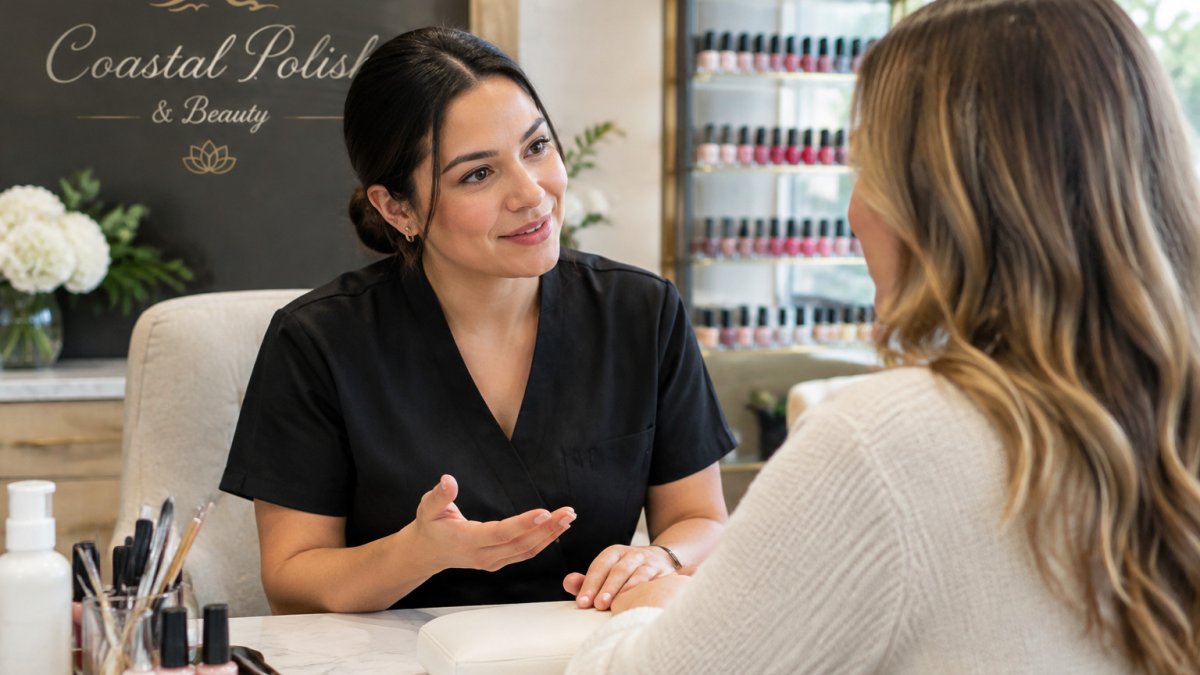
Start the appointment by stating your goal clearly. A simple opening helps the technician understand your desired look before any work begins.
Try a line like this:
"Hi, I'd like a square shape, medium length, and a soft nude color. Here's a photo of what I have in mind."
Ask one or two questions if something is unclear. For example, ask how long the set will last or whether removal costs extra. Pricing and service details can be confirmed on the Coastal Polish & Beauty website. Good communication at this stage prevents most disappointments later.
A Timeline of Check-In Moments During Your Service
Think of your appointment as a series of checkpoints, and treat each one as a good moment to raise a concern. Once a shape is filed and sealed under polish, correcting it usually means removing product and starting over, so feedback lands best before the next step, not after it.

- Consultation, before any tool touches your nails: Restate the shape, length, color family, and any design in one sentence, and show your reference photo. This is the cheapest moment to redirect the whole service.
- After filing and shaping, before the base coat: Look at the bare nails from the top and from the side. Check that the length is even across all ten and that the shape matches your plan. Ask for a change now, while the file is still the only tool involved.
- After cuticle work, before the base coat: Confirm the cuticle area feels comfortable and that no skin is raw or stinging. If a cuticle tool pinched, say so before product goes on.
- Before the color coat: Ask to see the shade on one nail, then step to a window or doorway and look at it in natural light. Overhead salon lighting shifts how a color reads, and a shade that looks right under the lamp can look different outdoors.
- Before any nail art, on one finger only: Ask for the design on a single nail first. Approving one sample nail is far easier to undo than approving a full set.
- Before the top coat: Make your final adjustment requests while the surface is still workable. Small fixes to shape or edge are simpler before the top coat seals everything.
- At the final inspection, before you leave the chair: Check all ten nails in natural light, look at the free edges, and confirm the length is even. This is the moment when an on-the-spot fix is still routine.
Watch out: the most common pattern is a client noticing an uneven length or a shape they dislike at the final inspection, when the technician has already moved on to the next client's setup. Raising it at the shaping checkpoint takes seconds; raising it at the end can mean a full redo or a return visit.
Checking Shape, Length and Color Before Polish
Look at your nails in natural light before polish goes on, and compare the length of the index and middle fingers side by side rather than one at a time. Overhead lights can make colors look different, so ask for a polish swatch and hold it against your skin near a window or open door.
A simple check works well: ask the technician to show a sample on one nail. If it looks right, carry on. If not, say so right away. A polite request like "Could we make it a little shorter?" is clear and easy to act on, and it is much easier to answer before the base coat than after curing.
Speaking Up About Pain, Heat or Discomfort
Tell your technician right away if you feel pain, a burning sensation, or unusual heat. Discomfort is a valid reason to stop, even mid-service.
Say something like:
"That feels hot. Could you pause for a moment?"
Speaking up protects your comfort and your nails.
The article suggests raising concerns at each checkpoint, which are summarised below.
| Checkpoint | What to check | Why now |
|---|---|---|
| Consultation | Shape, length, color family, design | Cheapest moment to redirect the service |
| After filing and shaping | Even length, shape matches plan | Changes are simple before base coat |
| After cuticle work | Comfort, no raw or stinging skin | Speak before product goes on |
| Before color coat | Shade on one nail, checked in natural light | Overhead lighting shifts color |
| Before nail art | Design on one finger first | Easier to undo one sample nail |
| Before top coat | Final shape or edge adjustments | Surface is still workable |
| Final inspection | All ten nails, free edges, even length | On-the-spot fixes are still routine |
Ready-to-Use Scripts for Common Situations
Having the words ready makes speaking up much easier. Use these lines as starting points:
- Shape is off: "Could we round the corners a little more?"
- Length is too long: "I'd like these a bit shorter, please."
- Color looks different: "This doesn't match the sample. Could we check the shade?"
- Design isn't right: "Could I see the design on one nail first?"
- Something hurts: "That's uncomfortable. Can we stop for a second?"
- Want a correction: "I'd like to fix one nail before we continue."
Keep your tone friendly and direct. Clients who explain politely get better results.
First-Time Visit: What to Ask For
On your first visit, ask about the process so there are no surprises. Useful questions include:
- What tools are used, and how are they cleaned between clients?
- How long will the full service take?
- What is the removal process if you want a change later?
- How long should the polish or set last?
Asking these questions early gives you a clear picture of what to expect.
What to Do If You Are Unhappy With Your Nails
Unhappiness comes in two very different forms, and they call for different responses. Sort your concern into one of these before you speak, because the wording and the urgency change with it.
A preference miss is when the result is safe but not what you agreed on: the shape is rounder than the square you asked for, the length is longer than you wanted, the shade reads warmer than the sample, or the design is off-center. These are correction requests, and the final inspection is the right time to make them. A calm, specific request is easier to act on than a general "I don't love it."
A safety concern is different: sharp pain, burning that does not fade when the lamp stops, bleeding at the cuticle, swelling, a rash, or a reaction that spreads. These are not preference issues, and you should ask the technician to stop the service rather than wait for the final inspection. Say plainly, "I need to stop, this is burning and it isn't easing." A reaction that continues after the product is removed, or any sign of infection such as spreading redness or pus, warrants medical attention rather than another salon visit.
How to Ask for a Correction Calmly
Name the specific nail and the specific change. "The middle finger on my left hand is a little longer than the others, could we take it down to match?" is far easier to answer than "something looks off." If the technician pushes back, restate the original agreement once: "We agreed on medium length and a square shape, and this one is longer and rounder." Keep your voice level and stay on the single point.
If the technician cannot make the change, ask what the options are before you pay. Get the answer in plain terms rather than a vague "come back later."
If the Problem Shows Up Days Later
Contact the salon and describe what you see, with photos taken in natural light. Avoid peeling or picking at the polish, since this can damage the natural nail. If the issue is pain, swelling, or a spreading rash rather than a cosmetic flaw, treat it as a safety concern first and seek medical advice before booking a repair.
Watch out: the most common mistake is waiting until you are home and frustrated, then sending an angry message days later. A specific, calm report with photos, sent within the first day or two, gets a faster and more cooperative response than a complaint that arrives after the salon has no way to verify what happened.
Booking Your Next Visit at Coastal Polish & Beauty
Speaking up gets easier with practice, and a comfortable salon makes it simpler. If you want to try this approach at a calm, welcoming space, Coastal Polish & Beauty offers personalized service in Newport Beach, located inside the Birdhouse wellness collective. You can book a professional manicure in Newport Beach for your next appointment. Before you go, read Questions to Ask Before Booking a Luxury Manicure to prepare your list.
Frequently Asked Questions
When should you speak up during a nail appointment?
Speak up at three points: before the service starts, when the technician shows you the shape and length for approval, and as soon as anything feels painful, hot or uncomfortable. Raising a concern early is far easier than fixing a finished set. A quick check before polish or enhancement product goes on lets the technician adjust filing or color without redoing work. If you feel a burning sensation during filing or curing, say so immediately rather than waiting for the service to end.
What should you say if you do not like your nails during the appointment?
Stay calm and be specific. Try a line such as, "Could we shorten this one slightly? I'd like the shape a bit more rounded." Naming the exact nail and the exact change makes it easy to fix. If the issue is color, ask to see a sample on one nail before the rest are done. Asking for an adjustment is a normal part of the appointment.
What should you ask for when booking a nail appointment?
When you book, mention the service you want, the approximate length and shape, and whether you need gel, dip powder or regular polish. Ask how long the appointment will take so you can plan your schedule and avoid feeling rushed. If you have sensitive skin or nails, say so when you call. A short note about your desired look or a reference photo sent ahead can prevent misunderstandings on the day of your visit.
Should you speak up if a nail service hurts?
Yes. Pain, heat or a burning feeling during filing, buffing or curing is a signal to stop and tell your technician right away. You can say, "That's uncomfortable, could we pause for a moment?" Do not wait until the appointment ends, because continuing through pain can irritate the nail bed and skin and make the discomfort harder to resolve.