 ultimate-guide
Why Luxury Nail Salons Use Non-Toxic Products
Table of Contents
- The Hidden Risks of Traditional Nail Salon Chemicals
- What Makes a Nail Salon Truly Non-Toxic?
- Benefits of 5-Free Nail Polish for Clients and Technicians
- Non-Toxic Manicure vs Traditional Manicure: What Actually Changes
- How to Identify Non-Toxic Nail Salons Before You Book
- Why Air Quality and Ventilation Define a Luxury Experience
- Frequently Asked Questions
Last Updated: September 30, 2026
The Hidden Risks of Traditional Nail Salon Chemicals
Walk into any traditional nail salon and you'll notice it within seconds: that sharp, acrid smell hanging in the air. According to the Occupational Safety and Health Administration, prolonged exposure to salon fumes can irritate the eyes, nose, and throat, and repeated contact with certain nail products is linked to skin sensitization and respiratory complaints among technicians. This guide from Coastal Polish & Beauty explains why luxury nail salons use non-toxic products, what those formulas actually leave out, and how to tell a genuinely clean salon from one that simply markets itself that way.
The shift isn't just marketing. It reflects a growing understanding that what goes on your nails eventually enters your body, and that the people applying it absorb far more than you do.
The Toxic Trio: Formaldehyde, Toluene, and Dibutyl Phthalate
Three ingredients have dominated the conversation about nail product safety for years. Formaldehyde is a preservative and hardener that the Centers for Disease Control and Prevention classifies as a known human carcinogen. Toluene is a solvent that affects the nervous system with heavy exposure. Dibutyl phthalate (DBP) is a plasticizer that helps polish stay flexible, and it's been linked to reproductive concerns in animal studies.
Many businesses find that clients who react to traditional polish, with redness, itching, or lifting nails, are reacting to one of these three rather than to the color itself. That's why so many premium salons now build their entire service menu around formulas that leave them out.
What Makes a Nail Salon Truly Non-Toxic?
A truly non-toxic nail salon is one whose products, ventilation, and hygiene practices all work together to limit chemical exposure, not just one whose polish bottles carry a clean label. The distinction matters because a salon can stock the best polish available and still have poor air circulation or lax sanitation.
Look for three things together:
- Products labeled free of formaldehyde, toluene, and DBP
- Active ventilation, including fans or purifiers, not just an open door
- Technicians who wear gloves and follow consistent tool sterilization
When all three are present, the environment feels different the moment you sit down. No lingering fumes, no headache an hour later.
The Science Behind 'Non-Toxic' Marketing Claims
Here's what most guides miss: "non-toxic" has no single legal definition for nail products. A brand can print the phrase on a bottle without meeting any specific standard. What carries real weight are the specific claims, like "5-free," "7-free," or "10-free," which name exactly how many concerning ingredients were removed.
This is where the science of non-toxic marketing gets murky. A polish labeled "10-free" isn't automatically safer than a "5-free" one; it simply excludes more ingredients. What matters is which ingredients are absent. Ask which specific compounds a salon's products avoid, and you'll quickly learn whether they understand their own inventory or are repeating a label.
Benefits of 5-Free Nail Polish for Clients and Technicians
The benefits of 5-free nail polish extend to everyone in the room. For clients, the most immediate difference is a manicure that doesn't leave a chemical smell on your hands or trigger irritation around the cuticle. For technicians, who spend hours each day with these products, the benefit is occupational: less daily exposure to solvents and sensitizers.
There's a practical upside too. Formulas without harsh plasticizers tend to behave differently, and many clients report less nail breakage and peeling over time. The trade-off is real: some 5-free polishes take slightly longer to cure and may need an extra coat for full opacity. That's a fair exchange for a service that doesn't leave you wondering what you just absorbed.
| Factor | Traditional Manicure | Non-Toxic Manicure |
|---|---|---|
| Key ingredients | Formaldehyde, toluene, DBP | Free of the toxic trio |
| Fumes | Strong, lingering odor | Minimal to none |
| Drying time | Fast | Slightly longer cure |
| Skin reaction risk | Higher | Lower |
| Best for | Occasional use | Regular clients, sensitive skin |
Non-Toxic Manicure vs Traditional Manicure: What Actually Changes
The core difference between a non-toxic manicure and a traditional one comes down to what's in the bottle and how the room is ventilated, not the finished look. Your nails can look identical afterward. What changes is everything you don't see: the air you breathe during the appointment and the ingredients sitting against your skin for the next two weeks.
Schedule and Appointment today for 10% Off your service →
Curing is one area where clients notice a shift. Non-toxic gels still require UV or LED curing, but the formulas are designed to minimize the sensitizers that cause allergic reactions over repeated use. If you've ever developed an itchy, red ring around a nail after months of gel manicures, that's often sensitization building up, and switching formulas is the usual fix.
How to Identify Non-Toxic Nail Salons Before You Book
Identifying a non-toxic nail salon takes about five minutes of asking the right questions. Call ahead or check the website for specifics rather than slogans, and pay attention to whether the answers are concrete.
Use this checklist before you commit:
- Ask which specific ingredients their polishes exclude
- Ask how the space is ventilated
- Ask how tools are sterilized between clients
- Look for brands named on the website, not just "premium products"
- Visit once and notice the air quality for yourself
A salon that hesitates on any of these is telling you something. At Coastal Polish & Beauty, our technicians use premium products and maintain high standards for health and comfort. If a salon can't explain its own practices, keep looking.
Why Air Quality and Ventilation Define a Luxury Experience
Air quality is the clearest signal of whether a salon takes chemical exposure seriously, because ventilation is expensive and hard to fake. A luxury experience isn't just plush chairs and calm music; it's a space where the air is genuinely clean.
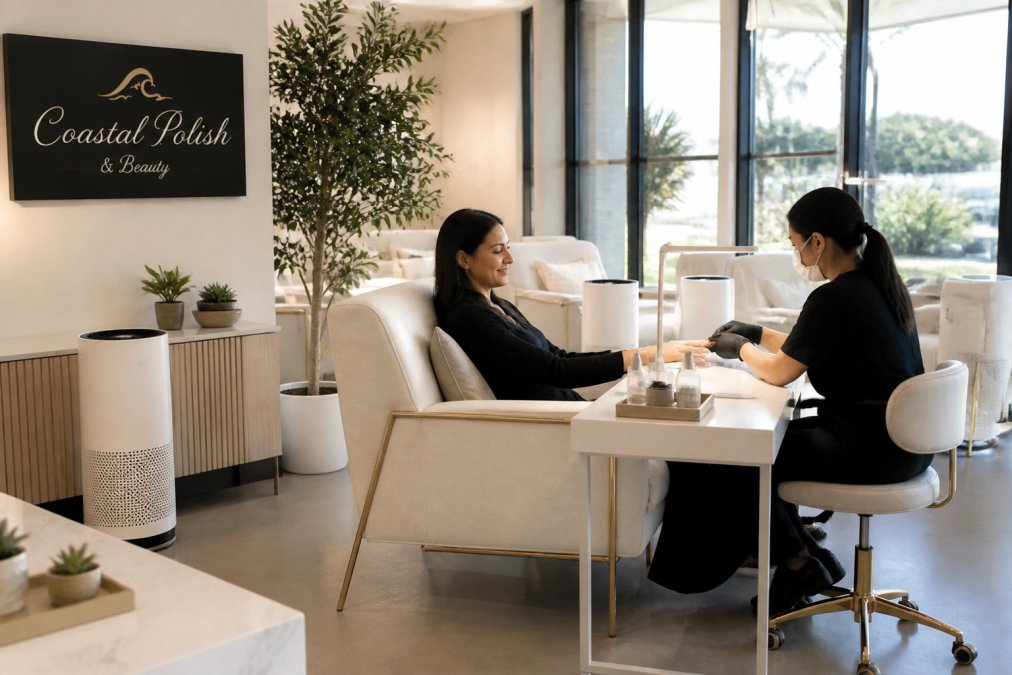
Salons that prioritize air quality typically run dedicated exhaust near each station and use filtration to capture fine particles. The result is a room that smells neutral rather than chemical. For clients with respiratory sensitivity, that difference is the whole point. For everyone else, it's the reason you leave feeling refreshed instead of drained.
Choosing a nail salon is really a decision about what you're willing to breathe and absorb during every appointment. Coastal Polish & Beauty was built around that question, with a newly renovated space, expert technicians using premium products, and a clean, safe environment designed for clients who want to relax and recharge without compromise. If you're ready for a manicure, pedicure, or Head Spa treatment that treats your health as part of the experience, book now with Coastal Polish & Beauty.
Frequently Asked Questions
What makes a nail salon non-toxic?
A non-toxic nail salon uses polishes and products free from the toxic trio (formaldehyde, toluene, and dibutyl phthalate), maintains strong ventilation to reduce fumes, and follows strict sanitation protocols. Look for 5-free or 10-free polish lines, hospital-grade sterilization, and staff who can name the specific ingredients they avoid. The best salons will happily explain their product choices and show you their safety practices without hesitation.
Are non-toxic nail products as durable as traditional formulas?
Modern non-toxic formulas have closed much of the durability gap. Modern non-toxic formulas have closed much of the durability gap. The key factors are the technician's application technique, proper nail prep, and using a compatible base and top coat. Cheaper non-toxic polishes may chip faster, so product quality matters as much as the absence of harsh chemicals.
How does a non-toxic environment improve the salon experience?
Fewer fumes mean cleaner air, which reduces headaches, dizziness, and respiratory irritation during your appointment. Clients with sensitive skin or allergies face lower risk of allergic reactions and skin sensitization from cyanoacrylate and other common ingredients. A non-toxic environment also signals that the salon invests in client well-being and professional standards, which typically translates to a calmer, more comfortable visit overall.
What should I look for to verify a salon's non-toxic claims?
Ask specific questions: which polish brands do you use, are they 5-free or 10-free, how do you ventilate the space, and what is your tool sterilization process? A legitimate non-toxic salon will answer without hesitation and may show product labels. Look for visible ventilation systems, sealed sterilization pouches, and single-use files. If a salon cannot name the chemicals it avoids, its non-toxic claim is likely marketing rather than practice.