 how-to
7 Scalp Exfoliation Moves That Beat Stubborn Dandruff
Last Updated: November 13, 2026
Quick Summary
The best scalp exfoliation for stubborn dandruff is a gentle chemical exfoliant paired with an anti-dandruff shampoo, used once or twice a week. Exfoliate before you cleanse so the treatment can reach the skin, and never exfoliate more than twice a week. Exfoliation is a support step, not the treatment itself, so stubborn dandruff also needs an appropriate anti-dandruff shampoo used on schedule.
- Patch test any exfoliant 24 to 48 hours ahead behind your ear or on your inner arm.
- Massage with fingertips, not nails, for two to three minutes using gentle pressure.
- Let medicated shampoo sit for the full contact time on the label before rinsing.
- Skip physical scrubs entirely if your scalp is sensitive or reactive.
- See a dermatologist if scaling spreads to eyebrows, ears, or beard area.
Table of Contents
- Why Stubborn Dandruff Needs More Than a Scrub
- Physical vs. Chemical Exfoliants: Which Handles Flakes Better
- Scalp Exfoliation for Stubborn Dandruff at Home: A Step-by-Step Method
- Choosing the Best Scalp Exfoliation for Stubborn Dandruff
- When a Scalp Scrub for Seborrheic Dermatitis Is Safe
- The Best Scalp Scrub for Buildup and Excess Oil
- How Often to Exfoliate and When to See a Dermatologist
- Book a Head Spa Session to Reset Your Scalp
- Frequently Asked Questions
Why Stubborn Dandruff Needs More Than a Scrub
If you have tried every scrub on the shelf and your flakes keep coming back, the problem is not your effort.
Dandruff is a scaling condition linked to a naturally occurring yeast on the scalp and to how quickly skin cells turn over. A scrub lifts flakes and product buildup from the surface. It cannot slow that turnover or calm the underlying irritation.
That distinction changes everything about how you build a routine. Get it right and the flakes start to fade. Get it wrong and you strip your scalp barrier, which makes itching and redness worse.
Telling Dandruff Apart From Dry Scalp, Psoriasis, and Seborrheic Dermatitis
Before you scrub anything, identify what you are actually dealing with. The four conditions below look similar in a mirror but need different care.
- Dandruff: white or yellow flakes on the scalp, mild itch, often worse in winter or under stress.
- Dry scalp: small, dry flakes with tightness, usually alongside dry skin elsewhere on the body.
- Psoriasis: thick, silvery scales on red plaques, often extending past the hairline to the ears and neck.
- Seborrheic dermatitis: greasy yellow scales with redness, commonly along the hairline, brows, and behind the ears.
A common mistake is treating dry scalp with an anti-dandruff scrub. If your scalp is dry, harsh exfoliation removes what little oil is there and makes flaking worse. If the scaling is thick, greasy, or spreading beyond the hairline, see a dermatologist before you exfoliate at all. The American Academy of Dermatology's guidance on seborrheic dermatitis is a clear starting point for telling these apart.
Physical vs. Chemical Exfoliants: Which Handles Flakes Better
For most stubborn dandruff, a chemical exfoliant works better than a physical scrub. Chemical options dissolve the bonds holding dead skin cells together, so flakes lift without friction.
Here is how the two compare in practice:
| Type | Examples | Best For | Watch Out For |
|---|---|---|---|
| Physical | Sea salt, sugar, jojoba beads | Buildup and oil on a healthy scalp | Micro-tears, redness on sensitive skin |
| Chemical | Salicylic acid, glycolic acid | Flaky, congested scalp | Over-drying if used too often |
| Enzyme | Fruit enzymes in gentle formulas | Sensitive scalp | Slower results |
The thing nobody tells you about physical scrubs is how much pressure people use. Scrubbing harder does not clear flakes faster. It creates micro-tears that sting when you apply medicated shampoo afterward.
Chemical exfoliants deserve their own caution. Salicylic acid is oil-soluble, so it reaches inside clogged pores and loosens scale, which is why it suits greasy, flaky scalps. Glycolic acid works on the surface and can sting on broken skin.
Scalp Exfoliation for Stubborn Dandruff at Home: A Step-by-Step Method
A safe at-home routine takes about ten minutes and follows a fixed order. The key is to exfoliate before you cleanse, not after, so the treatment can reach the skin. Skipping the prep steps and scrubbing harder are common reasons results disappoint, so follow the sequence below in order.
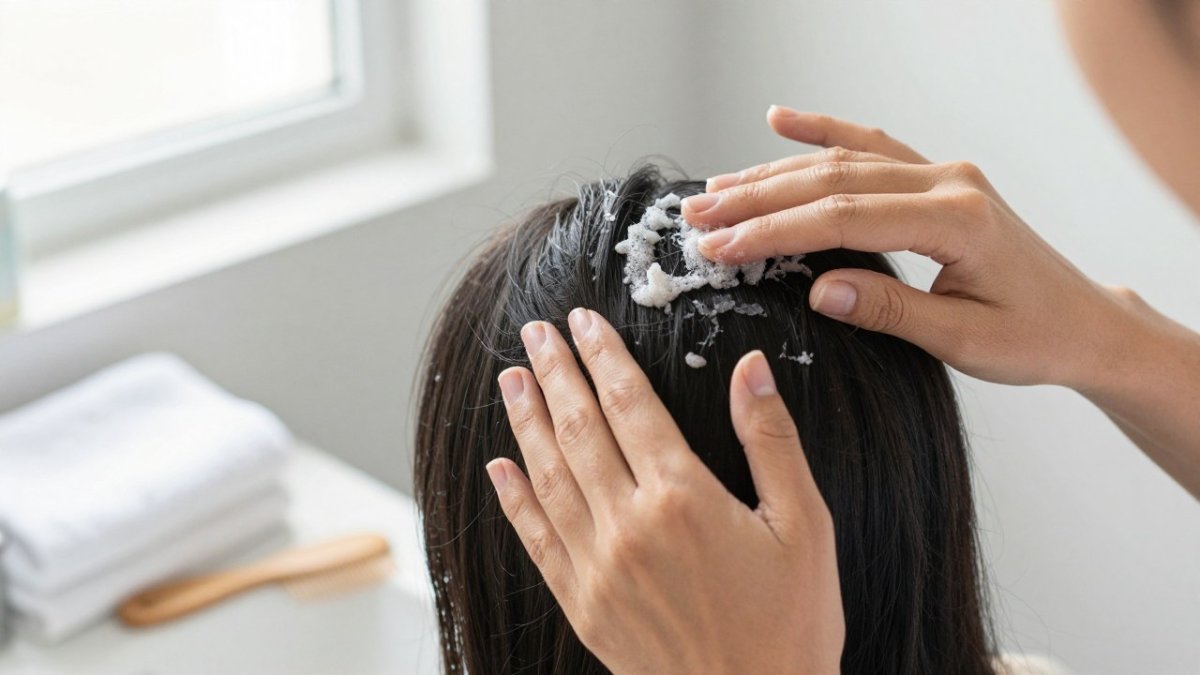
- Patch test 24 to 48 hours ahead. Apply a small amount behind your ear or on your inner arm and wait. If you react, you have saved yourself a scalp flare. This matters most with chemical exfoliants and anything fragranced.
- Brush first, on dry hair. Use a wide-tooth comb to lift flakes and loosen buildup before you wet your hair. Work from ends to roots so you are not dragging tangles through the scalp.
- Section your hair into four parts. Clip each section aside so you can see and reach the scalp, not just the strands. Part lines are where product collects, so they are where you start.
- Apply to the scalp only, along the part lines. Dot the exfoliant in small increments. It does not need to touch your ends, and more product does not mean faster results.
- Massage with fingertips, not nails, for two to three minutes. Use gentle pressure in small circles. If you would not press that hard on your eyelid, you are pressing too hard on your scalp.
- Rinse longer than feels necessary. Any scrub particles left behind can irritate the scalp. Tilt your head and work water along each part line.
- Follow with medicated shampoo and respect the contact time. Let it sit for the full time on the label before rinsing, cutting it short is one of the most common reasons a proven active underperforms.
- Moisturize the scalp, then stop. A soothing serum or light conditioner on the scalp helps restore comfort. Do not layer a second exfoliant or a strong active on the same day.
Watch out: exfoliating broken or inflamed skin is the fastest way to make dandruff worse. If your scalp stings, bleeds, or feels raw, stop and let it heal before your next session.
Pairing Exfoliants With Medicated Shampoos and Actives
The order matters more than the products. Exfoliate first to clear the surface, then apply your medicated shampoo so the active ingredient reaches the skin.
Do not layer strong actives on the same day. If you use a medicated shampoo regularly, our guide to head spa after medicated shampoo explains how a professional treatment fits into that routine.
A common pattern is to alternate rather than stack: exfoliate on one day, use your medicated shampoo on the next, and keep a rest day in between. If a clinician has prescribed a treatment, ask about sequencing before adding any exfoliant.
Choosing the Best Scalp Exfoliation for Stubborn Dandruff
The best scalp exfoliation for stubborn dandruff is a gentle chemical exfoliant paired with an anti-dandruff shampoo, used once or twice a week. Match the formula to your scalp type, not to the loudest label.
Use this checklist before you buy:
- Does it list salicylic acid, glycolic acid, or a gentle enzyme blend?
- Is it labeled color-safe if you have treated or colored hair?
- Is the particle size small if it is a physical scrub?
- Does it avoid heavy fragrances if your scalp is sensitive?
- Can you patch test it on your inner arm first?
For sensitive or reactive scalps, skip physical scrubs entirely. For curly and protective styles, choose a water-based chemical exfoliant you can apply with an applicator bottle, since scrubbing through coils causes friction and breakage. Whatever you pick, follow with a soothing serum. Our roundup of scalp serums for head spa aftercare covers what to look for in aftercare.
When a Scalp Scrub for Seborrheic Dermatitis Is Safe
A scalp scrub for seborrheic dermatitis is safe only when the skin is calm, not during a flare. During an active flare, the scalp is inflamed and the barrier is compromised. Friction at that point increases redness and can open the skin to infection.
Wait until scaling and redness settle, then introduce a mild chemical exfoliant once a week. Avoid salt and sugar scrubs, which are too abrasive for a reactive scalp. If your dermatologist has prescribed a treatment, ask before adding any exfoliant to the routine. Prescription treatments and exfoliants can interact, and the timing between them matters.
The Best Scalp Scrub for Buildup and Excess Oil
The best scalp scrub for buildup is one that clears sebum and product residue without stripping the scalp. Buildup from dry shampoo, styling products, and excess oil creates the perfect environment for flakes, so clearing it is a genuine part of dandruff care.
Look for salicylic acid, which cuts through oil, or a fine-particle scrub used with a light hand. Apply it to dry or damp hair, focus on the areas where product collects, and rinse thoroughly. If your scalp feels greasy again within a day, you likely need a deeper cleanse rather than a harsher scrub.
How Often to Exfoliate and When to See a Dermatologist
Exfoliate once a week to start, and never more than twice a week. Frequency of use is where most people go wrong. More sessions do not clear flakes faster, they just irritate the scalp and slow your progress.
A realistic timeline helps set expectations. Most people see less flaking within two to three weeks of a consistent routine, with continued improvement over a month or two.
Exfoliation is a support step, not the treatment itself. Stubborn dandruff usually needs an appropriate anti-dandruff shampoo used on schedule, and sometimes a prescription from a clinician.
Watch for these signs that it is time to see a dermatologist:
- Scaling spreads to your eyebrows, ears, or beard area
- The scalp is red, swollen, or weeping
- You notice hair thinning alongside the flakes
- Nothing improves after several weeks of consistent care
- The itch disrupts your sleep
- You have a flare that worsens despite treatment
If you are unsure whether to handle this at home or with professional help, our guide on what to look for in a scalp health specialist walks through the questions to ask. For a closer look at whether professional treatments help with flakes, read can head spa treatments help with dandruff.
Book a Head Spa Session to Reset Your Scalp
At Coastal Polish & Beauty, our Head Spa treatments are designed as a calming reset: careful attention to your individual scalp needs and a quiet space to recharge inside the Birdhouse wellness collective. Book your appointment online.
Our technicians work with premium products and hold high standards for hygiene and comfort, so sensitive scalps get careful handling.
Stubborn flakes rarely clear with one product. They clear with the right diagnosis, a gentle exfoliant used at the right frequency, and a treatment step that addresses the cause. When your scalp needs more than a shelf product can offer, we are here to help.
Frequently Asked Questions
Will a scalp exfoliator help with dandruff?
It can help, but it depends on the cause. Exfoliation lifts dead skin cells and product buildup that trap flakes against the scalp, which makes medicated shampoos work better. If your dandruff comes from a fungal overgrowth, a scrub alone will not clear it. Use exfoliation as a support step two to three times a week alongside an anti-dandruff shampoo containing salicylic acid or zinc pyrithione, and give it four to six weeks before judging results.
Can scalp scrubs make dandruff worse?
Yes, if you scrub too hard or too often. Aggressive scrubbing with coarse sea salt particles can cause micro-tears, redness, and irritation on an already inflamed scalp, which triggers more flaking. Sensitive or reactive scalps should start with a gentle chemical exfoliant like glycolic acid or a soft silicone brush instead of a gritty scrub. Always do a patch test 24 hours before full application, and stop if burning or swelling appears.
What is the best scalp scrub for buildup?
For buildup from dry shampoo, styling products, and excess sebum, look for a scrub that combines a mild physical particle with a clarifying agent. Salicylic acid is the most reliable ingredient for dissolving oil and clogged pores, while sea salt or sugar particles provide manual lift. Rinse thoroughly with lukewarm water, then follow with a regular shampoo. If your scalp stays greasy within a day of washing, exfoliate twice weekly and reduce heavy styling products.
When should you see a dermatologist for persistent dandruff?
Book a dermatologist if flakes persist after six to eight weeks of consistent anti-dandruff treatment, if you notice thick silvery plaques, spreading redness, or bleeding, or if hair loss accompanies the flaking. These signs point to psoriasis or seborrheic dermatitis rather than ordinary dandruff, and both need prescription-strength treatment. A scalp scrub for seborrheic dermatitis should only be used once a dermatologist confirms the diagnosis and clears exfoliation for your skin.