 how-to
Is It Safe to Get Gel Manicures Every Month
Table of Contents
- Understanding Gel Manicure Safety and Monthly Frequency
- How Often to Get a Gel Manicure Without Damaging Nails
- What Happens to Your Nails With Monthly Gel Applications
- The Right Way to Take a Gel Manicure Break Between Appointments
- How to Remove Gel Polish Safely to Protect Nail Health
- Essential Gel Manicure Aftercare for Healthy Nails
- Building a Sustainable Nail Care Routine
- Frequently Asked Questions
Last Updated: October 8, 2026
Understanding Gel Manicure Safety and Monthly Frequency
Is it safe to get gel manicures every month? For most people, yes, when done properly.
Your natural nails are living tissue that grows and regenerates constantly. Gel polish protects, but repeated applications stress your nail plate if you skip breaks and aftercare.
The key is balance. Getting gel manicures every month is fine if you follow these guidelines:
- Take breaks between applications (at least 1-2 weeks without gel)
- Remove gel polish correctly using professional techniques
- Moisturize your nails and cuticles daily
- Use strengthening treatments between appointments
How Often to Get a Gel Manicure Without Damaging Nails
The ideal frequency depends on your nail health and lifestyle. Most professionals recommend spacing appointments 3-4 weeks apart.
If you're getting gel manicures every month, your nails need extra attention:
- Schedule appointments exactly 4 weeks apart, not sooner
- Use a professional removal process (never peel or pick at gel)
- Apply cuticle oil daily between appointments
- Wear gloves when cleaning or doing dishes
Your nail plate needs time to regenerate. You can still get monthly manicures, just prioritize nail health between visits.
Some people with naturally strong nails tolerate monthly gel applications better than others. If your nails feel thin or brittle, extend the time between appointments to 5-6 weeks.
What Happens to Your Nails With Monthly Gel Applications
Repeated gel applications change your nail plate. Each cycle involves preparation, curing under a UV or LED lamp, wear, and removal. The damage is usually mechanical and moisture-related, not from the lamp itself.
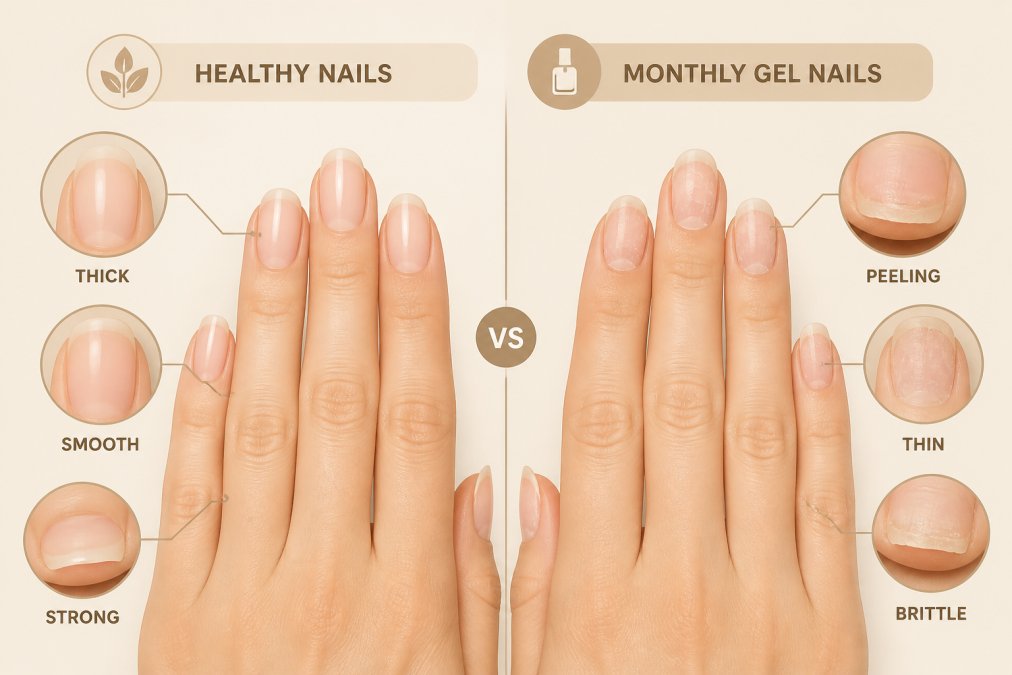
Here is what is actually happening at each stage:
- Preparation and buffing. Technicians lightly file the shine off the nail plate so the gel can bond. Done gently, this removes only dead surface cells. Done aggressively or every month without a break, it thins the plate and exposes softer layers underneath.
- Curing. UV and LED lamps emit UVA light. A single manicure delivers a small, brief dose, low-risk for occasional use, but cumulative exposure over years is why many clients apply sunscreen to their hands or wear UV-protective gloves with the fingertips cut out.
- Wear. Gel is a sealed, non-breathable layer. It blocks new moisture from entering, so the nail plate underneath dries out over the wear period.
- Removal. Acetone is the biggest variable. Soaking in 100% acetone for 10-15 minutes dehydrates the nail plate and strips oils. Peeling or picking the gel off instead removes layers of the natural nail with it.
When you get gel manicures every month without breaks, the usual result is a thinner, drier nail plate that peels at the free edge. The white edge splits more easily, and cuticles become dry and irritated from repeated acetone contact.
Triage: Is It a Chip, a Lift, or Nail Damage?
Before you repair, remove, or wait, identify what you're looking at. These three problems look similar but need different responses.
| What you see | What it is | What to do |
|---|---|---|
| A small missing piece at the tip, with intact gel around it | Polish chip | Safe to patch at home (see repair steps below) |
| Gel lifting at an edge, a pocket of air or moisture underneath, or gel that moves when pressed | Lifted gel layer | Do not seal over it. Water trapped under lifted gel can grow bacteria and cause a green discoloration (often called pseudomonas). Remove the lifted section or see a professional. |
| Pain, throbbing, redness, swelling, or a crack that goes into the nail bed | Damaged natural nail | Do not patch, glue, or apply gel. See a physician or dermatologist. |
Signs Your Nails Need a Break
Stop getting gel manicures temporarily if you notice:
- White spots or streaks appearing on the nail plate
- Nails feeling soft or bendy instead of firm
- Peeling or flaking that doesn't improve with moisturizing
- Pain or sensitivity at the nail bed
These signs mean your nails are stressed. A 2-4 week break lets them recover: keep nails short, moisturize with cuticle oil, and avoid enhancements like acrylics or dip powder that also require filing and acetone removal.
The Right Way to Take a Gel Manicure Break Between Appointments
Taking a break between gel manicures is one of the smartest things you can do for nail health, giving nails time to shed their outer layer and grow stronger.
How long should you wait between gel manicures? If you're getting gel applications every month, aim for at least 1-2 weeks without any gel polish.
During your break, follow this routine:
- Trim nails short to prevent breakage
- File edges smooth in one direction (never back-and-forth)
- Apply cuticle oil morning and night
- Wear gloves when washing dishes or cleaning
Your nails will look less polished during a break, but they'll be stronger, and it's temporary.
How to Remove Gel Polish Safely to Protect Nail Health
Improper removal causes more damage than the gel polish itself, critical when you're getting gel manicures every month. Professional removal takes 15-20 minutes.
The safe removal process involves these steps:
- File the shiny top layer (the seal coat) to break the gel's bond.
- Apply acetone-soaked cotton pads to each nail.
- Wrap each finger in foil to keep the acetone in place.
- Wait 10-15 minutes for the gel to soften.
- Gently push the softened gel away from the nail plate with a cuticle stick or orange stick.
- File away any remaining gel carefully.
- Buff the nail surface smooth.
- Moisturize immediately with cuticle oil.
Never peel, pick, or scrape gel polish off. It removes the top layer of your nail plate, leaving nails thin, weak, and prone to peeling for weeks.
If you remove gel at home, use 100% acetone (acetone-free removers don't work well on gel) and soak for the full time.
Schedule and Appointment today for 10% Off your service →
When Not to Remove Gel Yourself
Skip the DIY removal and book a professional if any of these apply:
- The gel is lifting in large sheets or has been on for more than four weeks.
- You see green, yellow, or dark discoloration under the gel.
- The nail is painful, swollen, or warm to the touch.
- You have a crack that extends into the nail bed.
Gel-Specific Repair: Fixing a Chip Without Removing the Whole Manicure
If you have a small chip at the free edge and the surrounding gel is firmly bonded (no lifting, no moisture underneath), you can repair it at home.
Tools you need:
- A fine-grit nail file (240 grit or higher)
- A buffer block
- 100% acetone and a small brush or cotton swab
- A gel base coat, a color matched to your manicure, and a gel top coat
Safe substitutes: A matching regular polish works short-term but won't cure hard and will chip again quickly. Never substitute nail glue for gel, see the warning below.
Step-by-step gel repair:
- Clean the area with acetone on a swab to remove oils and any loose gel dust.
- Gently file the chipped edge smooth, filing in one direction only.
- Lightly buff just the chipped area, do not buff the intact gel around it, or you will create a visible seam.
- Apply a thin layer of gel base coat over the chip, extending slightly onto the intact gel.
- Cure under the lamp for the time your product specifies (typically 30-60 seconds for LED, 2 minutes for UV).
- Apply color in thin layers, curing between each.
- Apply gel top coat and cure.
- Wipe off the tacky layer if your top coat requires it, then apply cuticle oil.
Repair Options by Chip Size and Location
- Tiny chip at the free edge: Gel repair steps above. Expect 5-10 days of wear before it needs attention again.
- Large surface chip or missing color over most of the nail: Remove the gel on that nail and start fresh. Patching a large area rarely looks seamless and tends to lift.
- Sidewall crack: Do not patch. A crack at the sidewall weakens the nail's structure and can spread into the nail bed. Remove the gel and keep the nail short until it grows out.
- Lifted edge with no chip: Do not seal. Remove the lifted section with acetone, or see a professional.
Making a Repair Last Until Your Next Appointment
- Keep the repaired nail dry for the first few hours.
- Wear gloves for dishes, cleaning, and any wet work.
- Apply cuticle oil daily, hydrated nails flex instead of cracking.
- Avoid using the nail as a tool (opening cans, scraping labels).
Essential Gel Manicure Aftercare for Healthy Nails
What you do after your appointment matters as much as the appointment itself. Proper aftercare prevents damage and extends your manicure.
Immediately after your appointment:
- Avoid water and moisture for 3-4 hours
- Don't apply lotions or oils until the gel fully sets
- Keep nails away from heat sources
For the next week:
- Moisturize your cuticles twice daily with oil or balm
- Wear gloves when cleaning or doing dishes
- Avoid exposing nails to harsh chemicals
- Don't use nails to open things or scratch surfaces
Throughout the month:
- Apply cuticle oil every morning and night
- Use a strengthening nail treatment 2-3 times weekly
- Wear gloves during household chores
- Limit exposure to water and harsh soaps
Hydration is the most important part of aftercare. Gel polish blocks moisture, so once it's removed your nails need hydration to recover. Cuticle oil penetrates the nail plate and restores moisture.
Building a Sustainable Nail Care Routine
Your daily routine should include:
- Morning: Apply cuticle oil to nails and cuticles
- Wear gloves for any wet work (dishes, cleaning, laundry)
- Evening: Apply cuticle oil again before bed
- Weekly: Use a nail strengthening treatment
- Monthly: Schedule your gel manicure appointment
This routine takes 5 minutes daily but makes a huge difference: stronger nails and longer-lasting gel manicures.
Consider rotating your nail treatments too.
Our expert technicians use professional removal techniques and premium products designed to protect your nails.
Your nails are unique, what works for a friend might not work for you.
Getting gel manicures every month is safe when you prioritize nail health between appointments.
Frequently Asked Questions
Can monthly gel manicures damage your natural nails?
Monthly gel manicures are generally safe when applied and removed properly, but frequent applications without breaks can weaken the nail plate, causing brittleness, peeling, and thinning. The risk increases if gel is applied every month without any rest periods. Taking a break every 2-3 months allows your natural nails to recover and regain strength. Proper removal using acetone soaking rather than picking or peeling is critical to minimize damage.
How often should you take a break from gel manicures?
Most nail professionals recommend taking a break of at least 1-2 weeks after every 2-3 gel applications. If you're getting gel manicures monthly, consider skipping one month every 3-4 months to allow your nails to fully recover. During breaks, focus on nourishing your nails with cuticle oil, moisturizer, and biotin-rich foods. This pattern prevents cumulative damage while still allowing you to enjoy regular gel manicures.
How should gel polish be removed to avoid nail damage?
Safe gel removal requires soaking your nails in acetone for 10-15 minutes to soften the gel, then gently pushing it off with a wooden or plastic tool, never pick or peel. Avoid metal tools that can scrape and damage the nail plate. Professional removal at a salon is the safest option, as technicians have the right products and technique. After removal, wash your hands thoroughly and apply moisturizer and cuticle oil to restore hydration to your nails and surrounding skin.
What should you do between gel manicure appointments to keep nails healthy?
Between appointments, keep your nails hydrated by applying cuticle oil or hand cream daily, especially after washing your hands. Wear gloves when cleaning or doing dishes to avoid exposing nails to harsh chemicals and water. Avoid using your nails as tools, which can cause breakage. If your nails feel dry or brittle, use a nourishing nail serum and consider biotin supplements. These practices protect the natural nail plate and reduce the risk of peeling, cracking, and lifting when you return for your next gel manicure.