 how-to
What Does 10-Free Nail Polish Mean for Your Nails?
Last Updated: November 4, 2026
Quick Summary
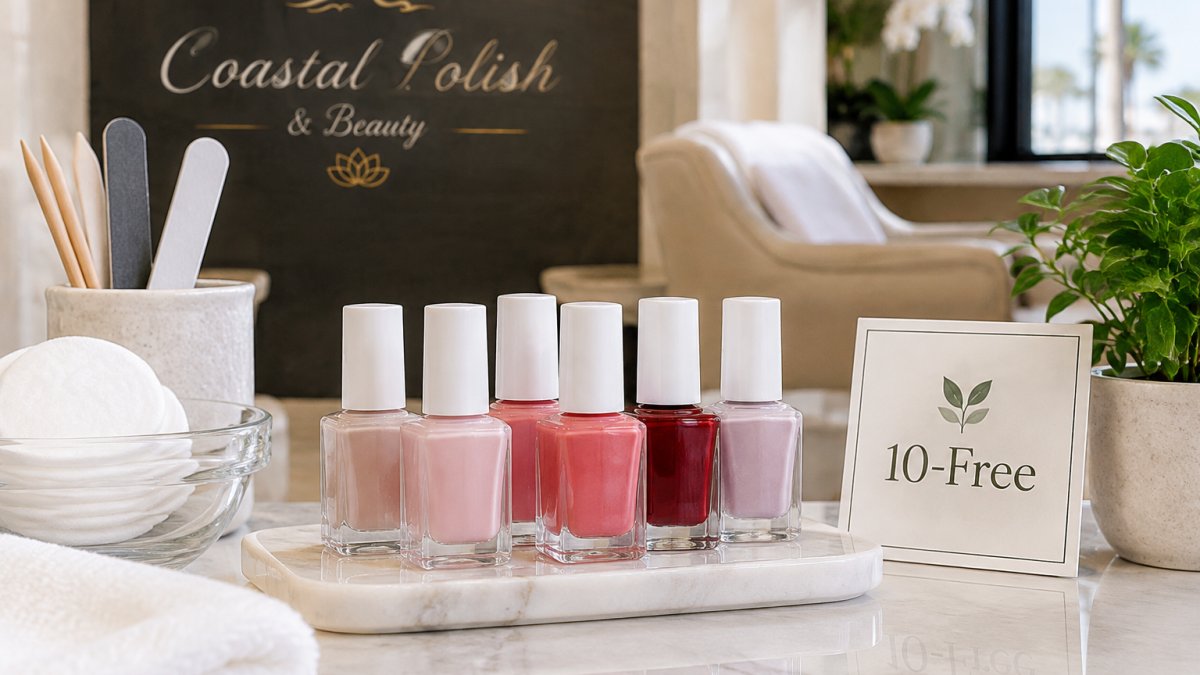
10-free nail polish is a formula made without ten specific ingredients traditional polishes commonly contain, including formaldehyde, toluene, and dibutyl phthalate. The label tells you what a bottle leaves out, not what it puts in, and no US agency certifies it, so each brand decides which ten ingredients to exclude.
- The free-from ladder runs from 3-free to 10-free, with each number adding more excluded ingredients.
- A 10-free label does not guarantee a polish is hypoallergenic, chemical-free, cruelty-free, or vegan.
- The jump from 5-free to 10-free adds five exclusions, but the practical difference is smaller than marketing suggests.
- Removing ingredients like toluene and DBP can change drying time, durability, finish, removal, and odor.
- Ask which brand the salon uses, what the ten exclusions are, and how tools are sanitized.
Table of Contents
- What Does 10-Free Nail Polish Mean?
- A Short History of the Free-From Labels
- What 10-Free Does Not Guarantee
- 10-Free Nail Polish Ingredients: The Ten Exclusions
- 10-Free vs. 5-Free Nail Polish: What Actually Changes
- Is 10-Free Nail Polish Safer? A Closer Look at the Evidence
- 10-Free Nail Polish Brands and How to Vet a Label
- The Regulatory Landscape and What Labels Really Require
- Choosing a 10-Free Manicure at Your Next Appointment
- Frequently Asked Questions
What Does 10-Free Nail Polish Mean?
10-free nail polish is a formula made without ten specific ingredients traditional polishes commonly contain, including formaldehyde, toluene, and dibutyl phthalate. The label tells you what a bottle leaves out, not what it puts in. The distinction is worth understanding, because "free" carries more marketing weight than legal meaning.
The short version: 10-free is a marketing claim, not a regulated standard. No US agency certifies it; each brand decides which ten ingredients to exclude.
Below, we break down which ingredients the ten exclusions usually cover, how 10-free compares to 5-free, and how to read a label without getting fooled.
A Short History of the Free-From Labels
The "free" numbering system started with the big three. As concerns about formaldehyde, toluene, and dibutyl phthalate grew in the early 2000s, some brands began selling "3-free" polish.
The ladder grew in steps:
- 3-free: no formaldehyde, toluene, or dibutyl phthalate
- 5-free: adds formaldehyde resin and camphor
- 7-free: adds ethyl tosylamide and triphenyl phosphate
The catch: no single body governs this ladder. One brand's 10-free list can differ from another's.
That inconsistency is the whole story of clean beauty labeling. The number sounds scientific. It is really a brand's own shorthand.
What 10-Free Does Not Guarantee
A 10-free label does not guarantee a polish is hypoallergenic, chemical-free, or risk-free. It only confirms the maker chose to leave out ten named ingredients.
- It does not mean the polish is chemical-free. Every polish contains solvents, film-formers, and pigments.
- It does not mean the formula is hypoallergenic. A 10-free bottle can still trigger reactions in sensitive people.
- It does not mean the brand is cruelty-free or vegan. Those are separate certifications.
The biggest mistake shoppers make is treating 10-free as a safety seal. It is a label a brand writes itself. What matters more is the full ingredient list and how the salon handles the product.
10-Free Nail Polish Ingredients: The Ten Exclusions
The ten exclusions in a 10-free formula typically cover three plasticizers and solvents, two formaldehyde-related compounds, and five other additives. The exact list varies by brand, but most 10-free polishes exclude these ten:
- Formaldehyde - a known carcinogen used as a hardener
- Toluene - a solvent linked to nervous system effects
- Dibutyl phthalate (DBP) - a plasticizer tied to reproductive concerns
- Formaldehyde resin - a related allergen and hardener
- Camphor - a plasticizer that can irritate skin
- Xylene - a solvent with fumes that irritate the eyes and throat
- Ethyl tosylamide - a film-former some people react to
- Triphenyl phosphate - a plasticizer under study for endocrine effects
- Parabens - preservatives some consumers choose to avoid
- Animal-derived ingredients - often gelatin or carmine
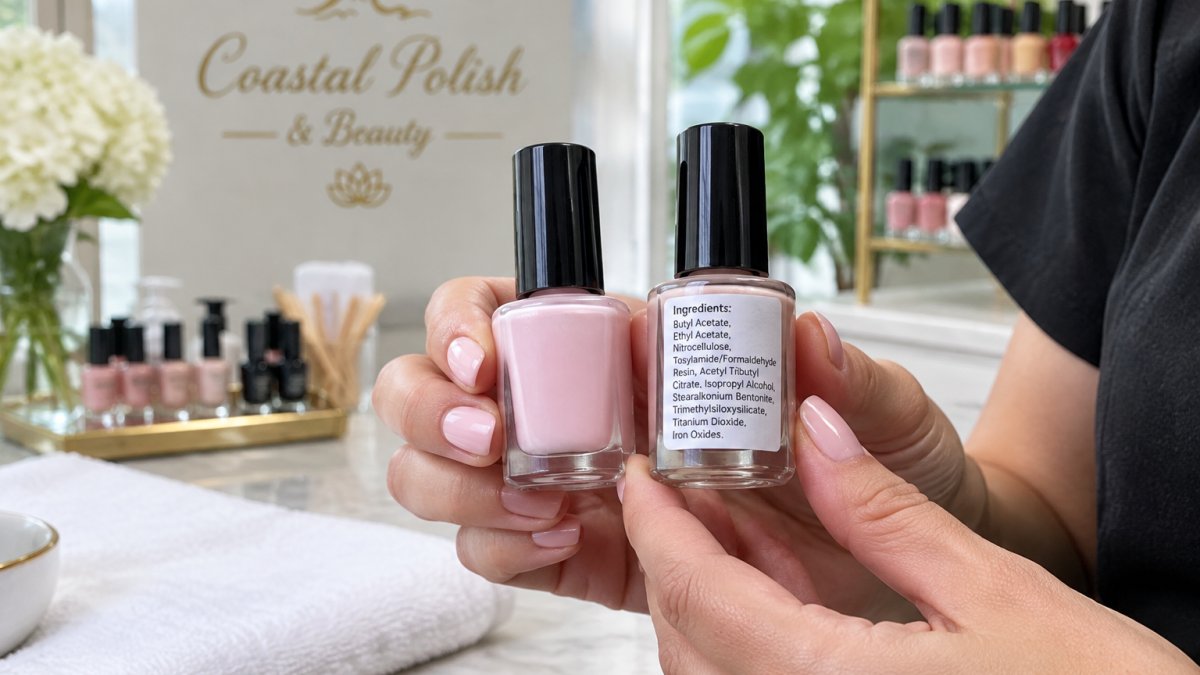
The Big Three: Formaldehyde, Toluene, and Dibutyl Phthalate
These three are the reason the free-from movement exists. Formaldehyde is a carcinogen and a common cause of allergic reactions around the nail. Toluene fumes can cause dizziness and headaches in poorly ventilated rooms. Dibutyl phthalate, a plasticizer that makes polish flexible, is classified as a reproductive toxicant in some settings.
If a polish is 3-free, it already excludes all three. That is the baseline. Everything above 3-free is a matter of degree.
The Next Seven: Resin, Camphor, and Beyond
The remaining seven are where labels start to differ. Formaldehyde resin and camphor are the usual 4th and 5th exclusions. Ethyl tosylamide and triphenyl phosphate often round out 7-free. Xylene and parabens usually appear at the 10-free level.
Watch out: a brand can call a polish 10-free while still using a related compound the label does not name. Always read the full ingredient list, not just the number on the front.
10-Free vs. 5-Free Nail Polish: What Actually Changes
The jump from 5-free to 10-free adds five more exclusions, but the practical difference is smaller than the marketing suggests. Both levels already remove the big three, and where they diverge most is how the formula behaves on the nail.
| Label | Typical Exclusions | What It Adds |
|---|---|---|
| 3-free | Formaldehyde, toluene, DBP | Baseline for clean polish |
| 5-free | Adds formaldehyde resin, camphor | Fewer allergens |
| 7-free | Adds ethyl tosylamide, triphenyl phosphate | Fewer solvents and plasticizers |
| 10-free | Adds xylene, parabens, animal ingredients | Broadest common exclusion list |
What the extra five exclusions do to the formula
Each removed ingredient was doing a job. Formaldehyde and formaldehyde resin act as hardeners. Toluene is a fast-evaporating solvent that carries the resin and helps level the film. DBP and camphor are plasticizers that keep the film flexible. Ethyl tosylamide and triphenyl phosphate are film-formers and plasticizers; xylene is a solvent; parabens are preservatives. When a brand removes them, it has to replace the function, not just the molecule.
That replacement is where performance differences come from:
- Drying time. Formulas that drop fast-evaporating solvents often rely on slower solvents or different resin blends, which can extend dry-to-touch time. Many 10-free polishes need two thin coats rather than one thicker coat.
- Durability. Without the traditional plasticizer package, some 10-free films are more rigid and chip at the free edge sooner, especially on flexible nails. Others compensate with a tougher top coat; wear time varies widely by brand.
- Finish and leveling. Toluene helps a film self-level and dry glossy; formulas without it can show brush strokes or dry duller unless a good top coat is used.
How to choose between 5-free and 10-free
The right level depends on why you are switching:
- If you have sensitive skin or react to standard polish, 10-free is worth the upgrade because it removes more known sensitizers and solvents.
- If you have no reaction and care mainly about the big three, 5-free already removes the ingredients most often flagged, and you may get better wear from a formula that keeps more of its traditional plasticizer package.
- If you are a technician or polish daily, the cumulative exposure argument favors the broader exclusion list, paired with good ventilation.
Is 10-Free Nail Polish Safer? A Closer Look at the Evidence
Is 10-free nail polish safer? Somewhat, for the ingredients removed, but the label is not proof of safety. The evidence supports removing the big three; it does not support treating 10-free as a guarantee.
Hazard vs. exposure: the distinction the label skips
A chemical's hazard rating describes what it can do at some dose; exposure describes how much actually reaches your body from a given product.
Schedule and Appointment today for 10% Off your service →
That framing explains why the same ingredient can be flagged in one context and tolerated in another.
That is not a reason to ignore the big three; it is a reason to treat '10-free' as one input among several rather than a safety seal.
What the science actually supports
- The big three are worth avoiding where you can. Formaldehyde is a known carcinogen and a common contact allergen; toluene and DBP carry documented concerns with repeated exposure. Removing them is a reasonable default, especially for technicians who handle polish daily.
- The tenth ingredient is a wildcard. Because 10-free is not standardized, you cannot assume which ingredient was removed or what replaced it.
- 'Free' does not mean 'inert.' Every polish contains solvents, film-formers, plasticizers, and pigments; the question is which chemistry and at what exposure.
FDA guidance on cosmetics and ingredient safety explains that cosmetic ingredients are largely self-regulated in the US, with no pre-market approval for most color additives and no certification of free-from claims. That means the burden of checking a formula falls on you and your salon, not on a government approval process.
The questions that actually change your risk
Rather than asking 'is 10-free safer,' ask:
- Which ten ingredients does this brand exclude, and what replaced them? A full ingredient list answers this; the front of the bottle does not.
- How is the salon ventilated? Local exhaust at the manicure table and general room ventilation reduce inhalation exposure more than most label changes.
- How often are you exposed? A monthly manicure and a daily at-home polish habit are different exposure profiles.
- Do you have sensitive skin or a history of contact dermatitis? If so, patch-test a new formula on a small area before a full application.
For a deeper look at how a luxury salon puts non-toxic standards into practice, see why luxury nail salons use non-toxic products.
10-Free Nail Polish Brands and How to Vet a Label
Plenty of brands now sell 10-free polish, but the labels are not equal. Vet a bottle with the same checklist you would use for any beauty product.
Use this checklist before you buy or book:
- Does the brand print the full ingredient list, not just "10-free"?
- Does the brand name which ten ingredients it excludes?
- Is the polish also labeled cruelty-free or vegan, with a real certification?
A common mistake is trusting the front of the bottle. The back tells the real story.
If you want to understand what higher product standards look like in practice, read about the benefits of medical-grade nail care.
The Regulatory Landscape and What Labels Really Require
In the US, no law defines "10-free." The term is not a regulated claim, so brands apply it however they choose.
That gap is why labeling transparency varies so much. A few brands publish full disclosure.
Because labels are weakly regulated, your best protection is the salon itself.
For a full list of red flags, read signs of poor nail salon hygiene.
Choosing a 10-Free Manicure at Your Next Appointment
When you book a 10-free manicure, ask three questions before you sit down: which brand the salon uses, what the ten exclusions are, and how tools are sanitized. A good salon answers all three without hesitation.
Our newly renovated space inside the Birdhouse wellness collective is designed around a clean, safe environment, and our technicians use premium products with personalized care.
Bring the questions that matter to you. A short list to ask when you book:
- Which polish brand do you use, and is it 10-free?
- Can I see the ingredient list?
- How do you sanitize tools between clients?
Before your visit, skim questions to ask before booking a luxury manicure so you walk in ready. When you are set, book an appointment for a manicure, pedicure, Head Spa treatment, or waxing service and let our team walk you through the products we use.
Frequently Asked Questions
What does 10-free nail polish mean?
10-free nail polish is a formula made without ten specific ingredients that have drawn concern in the beauty industry: formaldehyde, toluene, dibutyl phthalate, formaldehyde resin, camphor, xylene, ethyl tosylamide, triphenyl phosphate, parabens, and one additional compound depending on the brand. The label is a marketing standard, not a government certification, so the exact list can vary. Always read the ingredient list on the bottle rather than relying on the front label alone.
Is 10-free nail polish safer than regular polish?
It removes several ingredients linked to irritation and, in high-dose industrial exposure, more serious health concerns. That makes 10-free a reasonable choice for anyone with sensitive skin or frequent polish wear. But safer is relative: 10-free formulas still contain solvents and plasticizers, and no polish is chemical-free. Think of it as a lower-exposure option, not a risk-free one.
What is the difference between 10-free and 5-free nail polish?
5-free removes the five most publicized ingredients: formaldehyde, toluene, dibutyl phthalate, formaldehyde resin, and camphor. 10-free goes further by also excluding xylene, ethyl tosylamide, triphenyl phosphate, parabens, and one brand-specific ingredient. The jump from 5-free to 10-free matters most for people who react to solvents or who wear polish constantly. For occasional wear, the practical difference is smaller.
Does 10-free nail polish mean it is nontoxic?
No. 10-free means ten ingredients are left out, not that every remaining ingredient is harmless. Solvents such as butyl acetate and ethyl acetate still carry fumes, and plasticizers remain in most formulas. The term is a useful shorthand for a shorter exclusion list, but it is not a safety certification. Check for third-party testing or brand-published ingredient disclosures if you want stronger assurance.
The label on the bottle is a start, not the finish line. The salon behind it is what keeps your nails healthy. Get started with Coastal Polish & Beauty and enjoy a clean, calm appointment built around your needs.